Sound Delay
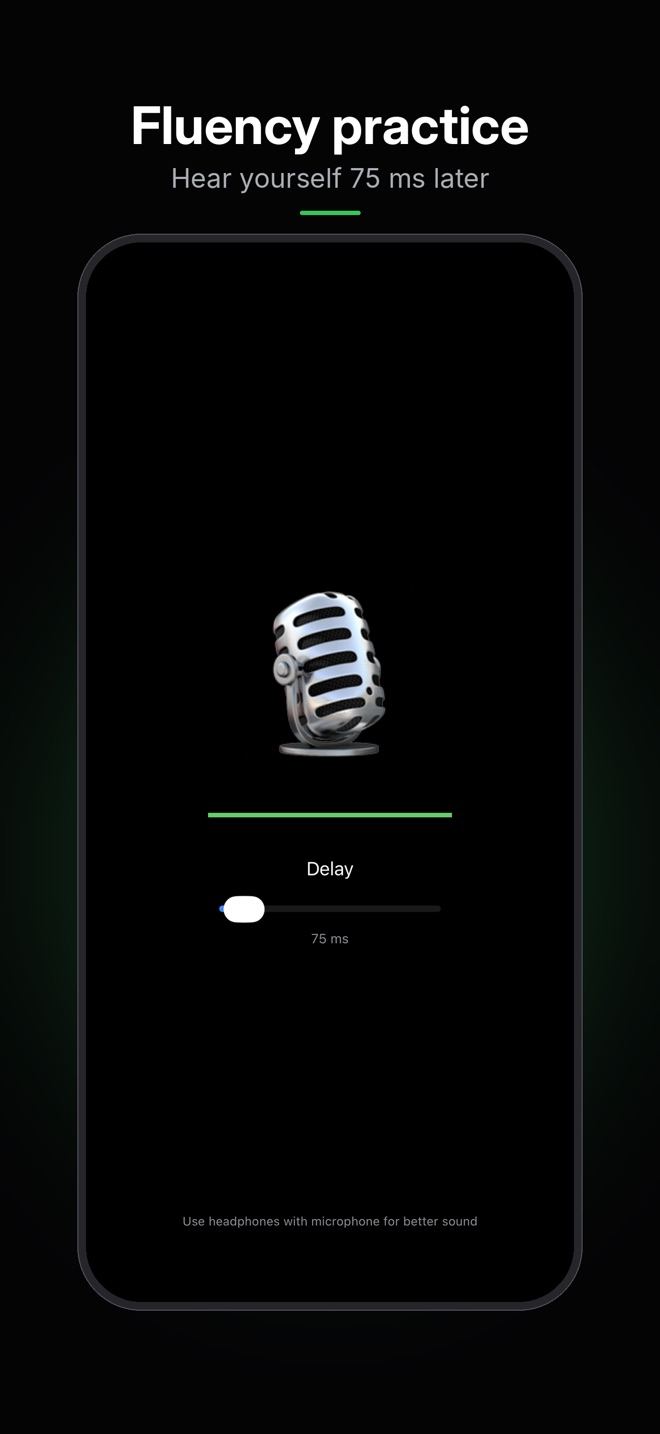
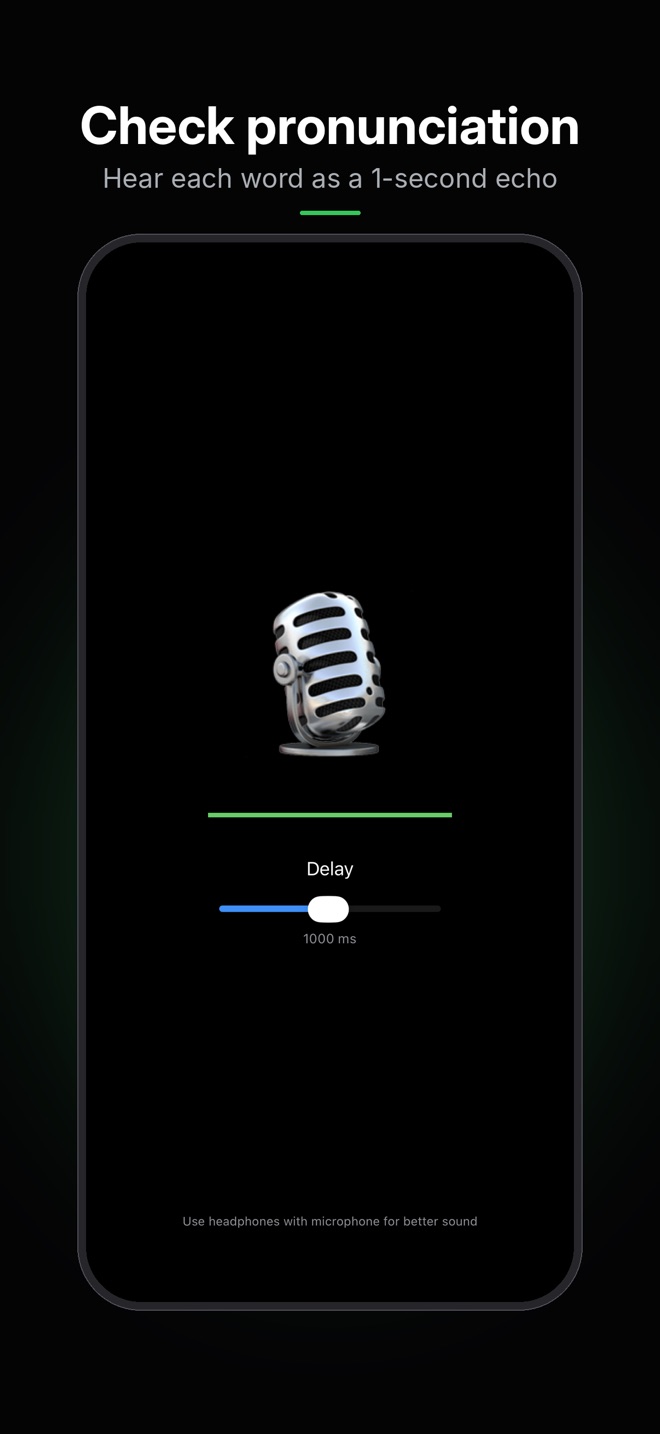
Sound Delay plays your voice back through your headphones after a delay you choose, from 25 milliseconds to 2 seconds. Tap the microphone, start speaking and you hear yourself just after you speak. Speech scientists call this delayed auditory feedback (DAF) and have studied it since the 1950s.
It helps in two different ways, depending on who's speaking and how long the delay is.
For language learners
Most of us don't hear our own accent while we're talking. We're too busy finding the words. With a delay of a second or more, your voice comes back as a clear echo, and you hear it the way a listener does.
- Say a word or phrase, then hear how it actually sounded
- Compare your echo with a native recording or your teacher, and adjust
- Catch vowels, stress and rhythm you didn't notice while speaking
- Repeat until the echo sounds right. No recording, no saving, no replay button.
Listening, comparing and adjusting is how pronunciation is learned. Sound Delay makes that loop as short as one sentence.
For people who stutter
Short delays have the opposite effect of long ones. Many people who stutter speak more fluently while they hear their voice slightly late, especially when reading aloud. This is the idea behind electronic fluency devices, and Sound Delay brings it to the iPhone and headphones you already have.
- Read aloud with a short delay and notice how your speech changes
- Use a longer delay to practice slow, prolonged speech
- Shorten the delay step by step as you get comfortable
Sound Delay is a practice tool, not a medical device. It doesn't diagnose, treat or cure any condition. If you stutter, we recommend using it together with a speech-language pathologist, who can help you find the settings and exercises that suit you best.
Suggested settings
| Goal | Delay | Why |
|---|---|---|
| Fluency practice | 50–75 ms | The range used in most recent stuttering studies |
| Slow, deliberate speech | 150–200 ms | The classic DAF range for slowing speech down |
| Pronunciation check | 1 s or more | Long enough to hear yourself as an echo and compare, without the speech-disrupting effect of short delays |
Use headphones with a microphone. Hearing the feedback in both ears works better than in one, and headphones keep the iPhone speaker from echoing back into the mic. Bluetooth headphones add a delay of their own, so for the short settings wired headphones are the most accurate.
Features
- One tap to start and stop
- Adjustable delay from 25 ms to 2 seconds
- Remembers your last delay
- Works with wired and Bluetooth headphones
- Nothing is recorded or saved: your voice only passes through
- No account, no ads, no internet connection needed
The science
Delayed auditory feedback has been studied for more than 70 years. Here's what researchers have found.
Fluent speakers slow down
When fluent speakers hear themselves about a fifth of a second late, they often slow down, stretch sounds or stumble. This is the classic DAF effect, first described in the 1950s, and it's why long delays work best for pronunciation practice.
Many people who stutter become more fluent
Reviews of decades of studies report fewer disfluencies under DAF, most clearly during oral reading. Researchers recommend combining it with traditional speech therapy.
Gauvin, systematic review of altered auditory feedback in adults who stutter, University of Vermont. Link
How clinicians use it
Typical clinical delays range from 50 to 200 ms. Newer studies favor 50–75 ms, where people keep a natural speaking rate. A classic approach starts with longer delays to train slow, prolonged speech, then shortens them step by step.
Lincoln, Packman & Onslow (2006), Journal of Fluency Disorders 31(2):71–89. Link
Better pronunciation for language learners
A four-year research project in Japan used delayed feedback while learners practiced English. Correct pronunciation of basic vocabulary rose from about 50% to about 70%, with the biggest gains among elementary school children.
Oiwa, JSPS KAKENHI project 26370749 (2014–2018). Link
In a study of 35 advanced English learners, practice in which students listened to and imitated their own voice was linked to better pronunciation and rhythm.
Kusz (2021), European Conference on Language Learning. Link
What you need
- An iPhone with iOS 15.6 or later
- Headphones with a microphone (recommended)
Privacy in short
Sound Delay uses the microphone only while it's on, and only to play your voice back to you. Nothing is recorded, stored or sent anywhere. The app has no accounts, analytics or ads, and doesn't connect to the internet. Read the full Privacy Policy.
References
- Lincoln, M., Packman, A. & Onslow, M. (2006). Altered auditory feedback and the treatment of stuttering: a review. J Fluency Disord 31(2):71–89.
- Gauvin. The Effects of Altered Auditory Feedback (AAF) on Fluency in Adults Who Stutter: A Systematic Review. University of Vermont.
- Oiwa, S. Speech Effect Study of Delayed Feedback System: Facilitating Self-Adjustment in English Learners. JSPS KAKENHI 26370749, 2014–2018.
- Kusz, E. (2021). Imitation and Self-imitation Practice on L2 Pronunciation Progress. ECLL 2021.